NEW SCARE CITY

It's a fictional streetscape we wander, here, a metropolis whose buildings, boulevards, and back alleys are in a constant state of flux. This is every place, and yet, no place at all - a city of dreams and a dream of a city.

Here, we explore the life and work of Ivan Illich and his circle of collaborators. There's no comprehensive index to the articles published, but we invite you to use the Search box, to the left, and to explore the Archive links that appear at the bottom of each page. Comments are welcomed.

Friday, December 07, 2012

Home movies


An extraordinary glimpse into, well, the extraordinary early life of Ivan Illich has turned up at, of all places, the United States Holocaust Memorial Museum, in Washington, D.C. There, in the Steven Spielberg Film and Video Archive, one of Illich’s relatives has deposited twenty reels of 16mm home movies shot in the momentous years 1936 to 1943.

Evidently, Ellen “Maexie” Regenstreif, Illich’s mother, was an avid movie-maker. She not only filmed Ivan and his twin brothers at home and on various vacations, she also took the time to edit her films and add titles throughout. She shot in black-and-white and in color (using Agfa and Kodak film); the footage is silent, with no audio. And she bothered to capture some remarkable scenes, perhaps most notably the family (mother and three boys) packing its belongings into a truck and handing over to leather-coated Nazi officials the keys to the expansive Regenstreif villa in Vienna.

We’ve not actually seen any of this footage, we’ve only read about it. The site labels the film reels as “rights restricted.” As we understand it, that means they may be available for viewing, in video format, by appointment but only at the museum itself. It’s not possible, except perhaps with special permission, to order copies.

Still, the Spielberg archive’s web pages provide fairly detailed descriptions of what each reel of film shows -- perhaps provided by Yvonne Illich, the daughter of Illich’s brother Sascha (1928-2009). She is listed as having given the films to the archive.

It’s hardly news that Ivan Illich grew up amongst wealth, tended to by a governess, an art tutor (from Bremen) and chauffeurs. Among other features, Villa Regenstreif had its own bowling alley and a “Chinese garden.” From the pictures we’ve seen, it was a remarkable place. Yet, the descriptions of these home movies hint at a particularly warm, playful, and art-filled family life. Judging by photos we’ve seen elsewhere and by these descriptions recently found on the Web, Illich’s mother must have been very special, a woman deeply engaged with, and much loved by, her three sons.

The archive has organized Maexie’s home movie reels into four groups. They are listed as Tape Numbers 2911, 2912, 2913, and 2914. Each reel is given its own page and description.

Here is the archive's general explanation of the family and films’s history (which we’ve broken into paragraphs for easier reading):

A collection of twenty reels [we count only 18 reels; perhaps a couple have been merged into one - ed.] of 16mm film dating from 1936 to 1943 illustrating the daily life of a prominent Austrian family named Regenstreif and Illich. The films were taken under the name Maexie.

Ellen (Maexie) Regenstreif Illich (1901-1965) came from a family of converted Sephardic Jews who had settled in Germany. Her industrialist father, Fritz (Pucki) Regenstreif (1868-1941), had a lumber business in Bosnia where he owned a sawmill at Zavidovic. He also owned an Art Nouveau villa on the outskirts of Vienna in Pötzleinsdorf built by Friedrich Ohmann.

Piero Ilic (1890-1942) came from a landed family in Dalmatia, Yugoslavia with property in Split and extensive wine and olive oil producing estates on the island of Brac.
Ellen and Piero married in 1925 and established a home in Split. There was a resurgence of anti-foreign and anti-Jewish sentiment in Yugoslavia and the Yugoslav government made claims against her father as a landowner in Bosnia at the International Court in the Hague, so in 1932, Ellen returned to her father's villa in Vienna with their three children: Ivan (1926-2002), Michael (Micha) (b. 1928), and Alexander (Sascha) (1928-2009). The boys never saw their father again; Piero died of natural causes in Split in July 1942.

After the death of Ellen's father on May 8, 1941 and the forced sale of his splendid home to the Nazis in 1942, Ellen moved with the children to Florence, Italy by way of Split, where they lived for three months. In Nazi Austria, Ellen was considered an ethnic Jew although she was a baptized Christian, and the children were classified as half-Jewish.
The films were kept in a wooden cabinet in the basement of Sascha's New York home from 1961 to 2006, when they were preserved by the United States Holocaust Memorial Museum.

And here is the archive’s description of the second reel in the collection, shot in 1936; Ivan would have been 10. All of the other reels get described in similar detail and are well worth reading. (We've added the hyperlinks seen here, by the way.):

Introduced with German titles throughout, some are comical. This film is titled "Dreibubenhaus" [The House of the Three Boys] in honor of a then current theatrical presentation in Vienna. CUs [close-ups], the twin boys don hats and joke for the camera. Sequence of the boys waking up, saying prayers, washing faces, getting dressed, and ready for school. The three Illich boys eat breakfast and exit their home (filmed from mother Ellen (Maexie) Regenstreif's room on the top floor of the villa), walking the grand grounds of Villa Regenstreif. The governess "Selli" Frauer escorts the boys onto a tram and kisses them goodbye as they enter school. Pan of the city square with the school on one end, panning up to the grand Baroque Piarist Church of Maria Treu. The boys eat lunch with their grandfather, Fritz Regenstreif, and governess. Views of the ornate home. CUs of the boys eating.

01:05:34 Sascha and Micha play the piano and the violin with teacher and friend Olga Novakovic [a student of Arnold Schoenberg], and then sit at their desks and do their homework. Ivan holds a little bird named Hansi. The twins play with a wooden model house. The three boys say their prayers, kiss each other good night and go to sleep.

01:08:24 Part 2 - on Sunday. Pan of the Vienna skyline from the top of the landmark highrise building at Herrengasse ("Hochhaus Herrengasse", built in 1931-32 by architects Theiss and Jaksch, was Vienna's first highrise). The boys chase a car as it drives by the camera. The family makes a trip to the grave of their grandmother, Johanna Regenstreif (d. 1934), in Potzleinsdorf.

01:09:43 The boys go sledding in winter on the meadow of "Wasserturm". For Three Kings Day, the family dresses in costume and act for the camera. The women -- Maexie, friend Vita Kuenstler [who worked at the Neue Galerie and apparently took over its management when it was Aryanized], and the governess -- playfully hassle one another. One of the twins is costumed as Hans Albers, and another as Michael Moser [probably 'Hans Moser', a prominent film and stage actor of the 1930s whose role as the muckraking civil servant ("Amtsdiener" as the intertitle suggests) were legendary].

01:12:56 Blossoms on the trees in springtime, followed by a sequence in autumn with the family visiting Vienna's most famous overlook at Leopoldsberg (a church and estate at the top of a hill). They continue on to the monastery at Klosterneuburg and pose for a photograph at St. Leopold with their grandfather.

01:15:10 Children gathered around a table with sweet treats for a birthday tea party. Ivan sits next to his friend, Marion Stein (daughter of Erwin Stein, a very important colleague of Mahler, Bartok, Weber).


Friday, November 23, 2012

Barcelona, too

We are pleased to hear from a reader, Silvia Grünig, who writes:

In this moment I'm finishing my Ph.D. thesis Ivan Illich: la ville conviviale at IUP-Institut d´Urbanisme de Paris, with M.Thierry Paquot.

Unhappily there is no Ivan Illich reader's group in Barcelona, but on 2th december a mess will take place at 11.30 at Parroquia Sant Jaume, Hermanitas del cordero, Carrer Ferrán 28, 08002 Barcelona, and a few friends will eat together.

Paquot, a professor of urban studies, authored a tribute to Illich in Le Monde in January, 2003. He also wrote the preface to the Ouvres completes collection of Illich's work. And he is one of the organizers of the 3-day Illich event scheduled to take place next week in Paris. Additional information about that colloquium has been made available here and a program is available here. Ms. Grünig will be one of the speakers, providing an update on her research.

Thursday, November 22, 2012

And another, in Bozen - "For a friendly future!"

Another Illich event - Dec. 17, in Bozen, aka Bolzano, Italy

Bozen, 17. Dezember 2012 um 17.30 Uhr (Altes Rathaus): Für eine freundliche Zukunft! - Eine Überlegung zur Ökologische Wende und deren Wünschbarkeit, nach Rio 2012 und zum Todesjubiläum von Ivan Illich. Franz Tutzer, Franz Egger, Riccardo della Sbarba, Alberto Filippi, Hans Schmieder, tauschen Meinungen und Lösungsvorstellungen mit dem Publikum.

Illich bio available in Italian

Martina Kaller-Dietrich's biography of Ivan Illich has been translated into Italian. What appears to be a review is published here.

Any plans for an English translation?

Wednesday, November 21, 2012

An event in Bologna

And yet another Illich event, planned for Monday, Dec. 17. Mr. Franz Tutzer -- a longtime Illich scholar and author of this impressive bibliography of Illich's work -- kindly sent us this:

Lettura Dossetti 2012

Tuesday, November 20, 2012

Yet another celebration, in Bern

We've been informed of another celebration of Ivan Illich, scheduled to take place Dec. 6 in Bern, Switzerland. A flyer for the event reads like so:


Ivan Illich interpretiert das Gleichnis vom Samariter

Donnerstag, 6. Dezember 2012, 20 Uhr, im Berner Münster


Ivan Illich, geboren 1942 in Wien und verstorben vor 10 Jahren, am 2. Dezember 2002, studierte Naturwissenschaften, Philosophie und Theologie. 1961 gründete er in New York das «Center oft intercultural Formation». In der Folge setzte er sich in der Lehre und in seinen Tätigkeiten in Nord- und Zentralamerika und in Europa (auchin seinem Schrifttum) intensiv mit den Grundlagen der abendländischen Kultur und der Rolle des Christentums auseinander. Vieles davon stellte er radikal in Frage. Er empfiehlt, das theologische Wirken und das spirituelle Leben als lebendige Sorge für die Menschen in unserer Zeit zu verstehen.
Zu seinen wichtigsten Schriften gehören: ‚Entschulung der Gesellschaft‘, ‚Die Nemesis der Medizin‘, ‚Genus. Zu einer historischen Kritik der Gleichheit’ und ‚In den Flüssen nördlich der Zukunft. Letzte Gespräche über Religion und Gesellschaft‘.

Das Gleichnis vom barmherzigen Samariter (Lk 10, 25-37) aus dem Lukas Evangelium war der Leitstern im Leben des Historikers und gläubigen Christen Ivan Illich, eine Textstelle, um die sein Denken und Tun kreiste. Dabei interpretierte er die Geschichte, mit welcher Jesus die Frage eines Schriftgelehrten „Wer ist mein Nächster?“ beantwortete, in einer neuen und radikalen Weise. Der Samariter, der den geschlagenen Juden aufhob und seine Wunden verband, handelte nicht nach einer Regel oder einem vorher gesetzten „Soll“, als er sich dem Mann aus einem fremden oder gar feindlichen Stamm zuwandte. Er handelte in freier, frei gewählter Zuwendung. Diese Zuwendung birgt seitdem die Möglichkeit, ein einzigartiges Verhältnis zu einem anderen Menschen herzustellen, ein Verhältnis jenseits aller Normen. Für Ivan Illich stiftete also Jesu Auskunft im Lukas Evangelium eine bis dahin undenkbare, ja anstössige Grundlage, um die höchste Form der Bezüglichkeit zu einem anderen Menschen durch einen freien Akt herzustellen.

Barbara Duden, Professorin für Soziologie an der Universität Hannover und langjährige Le-bensgefährtin von Ivan Illich, stellt die Texte vor und kommentiert sie.

Henriette Cejpek, Schauspielerin am Stadttheater Bern, liest Texte von Ivan Illich.

Sandra Mangini, Sängerin und Schauspielerin, Venedig, singt traditionelle italienischeLieder.

Der Abend ist gleichzeitig Abschluss der fünfjährigen Auslegung des Lukas Evangeliums durch Maja Zimmermann-Güpfert, Münsterpfarrerin.

Jean Robert video

Some video has appeared on YouTube showing Jean Robert discussing his friend and collaborator, Ivan Illich. The animated Robert is seated in a plush arm chair that swivels, talking in Spanish with several other people seated around a coffee table. There are two clips, actually, one 28 seconds long, the other nearly 8 minutes. Both have the title: "Seminario Iván Illich." Here's the longer one:


And the shorter one:

A Recent Paper Available Online

Last month, here, we noted the publication of a paper, "Ivan Illich's Late Critique of Deschooling Society: 'I Was Largely Barking Up the Wrong Tree'," by Rosa Bruno-Jofré and Jon Igelmo Zaldívar. We've just noticed that the full text of this paper, in a journal called Educational Theory, is available on line right here.

[CORRECTION: As of Jan. 1, 2013, the link we provided here no longer works.]

Monday, November 19, 2012

More celebrations, at State College and in Antwerp

Just as we were saying to a friend that it seemed no events were planned in the U.S. to mark the tenth anniversary of Ivan Illich's death, word has arrived that there will, in fact, be a small celebration at Penn State. And we've also been informed of an event planned for Antwerp, Belgium.

The Penn State affair will take place Dec. 3, from 7 to 8:30PM, with a panel of faculty members remembering Illich's life and contributions. All are welcome to attend, light refreshments will be served. The event will be held in 112 Walker Building. More information is available from the estimable Dana L. Stuchul.

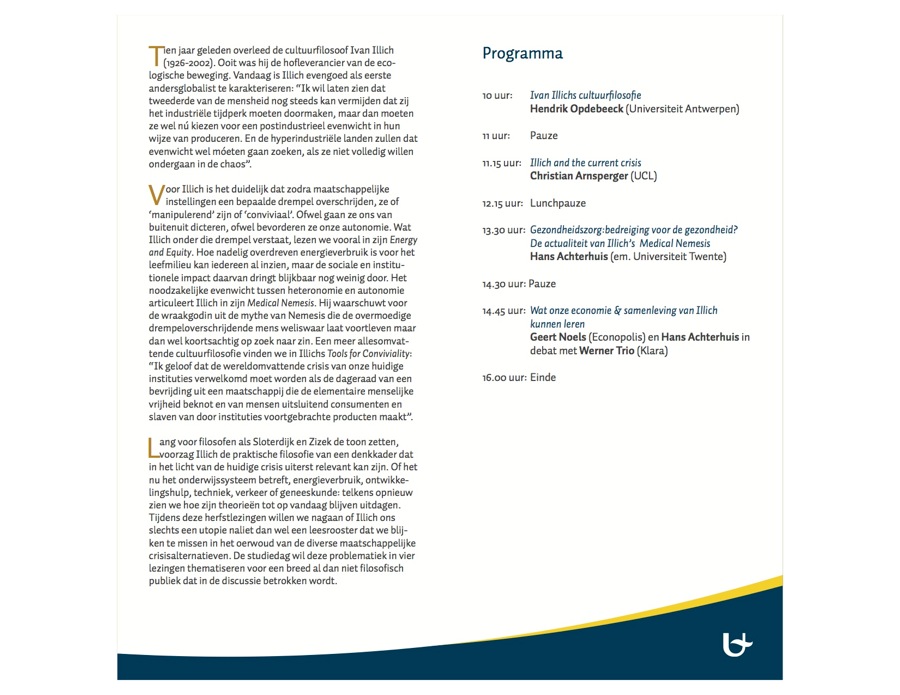
The Antwerp event is to take place Dec. 1 at the university there. One of our spies, reporting from Holland, writes:

It's from 10 till 16, and the speakers will explore the legacy of Illich. The flyer says they "wish to explore whether Illich left us a utopia, or a guide we're currently missing in the jungle of alternatives for the crisis" (free translation). There will be three lectures, concluded with a debate between the speakers. Of the speakers, the only one I'm familiar with is Hans Achterhuis, our "denker des vaderlands" (thinker of our country, some sort of title they give to a philosopher each year). Occasionally I stumble across an article or interview with him, in which he quite regularly quotes Illich. In the Netherlands, he is somewhat famous for his book De markt van welzijn en geluk (The market of well-being and happiness, I don't know wether it is translated in other languages) in which he gives a critique on our welfaresystem, based on Illich.


Illich flyerIllich 2

Monday, November 05, 2012

Illich in Russian

We've just stumbled onto a crowd-sourced translation project whose goal is to produce a Russian translation of Ivan Illich's Tools for Conviviality (Инструменты для добрососедства). Only 2% of the book has been translated, so far. All who can help are invited to join in. The same website, Translatedby.com, also is hosting a similar English-to-Russian translation of Deschooling Society, or Дешколирование общества.
Powered By Blogger

Moi

Santa Rosa, California, United States
Writer, photographer, music fan; father and husband living in northern Calif.