NEW SCARE CITY

It's a fictional streetscape we wander, here, a metropolis whose buildings, boulevards, and back alleys are in a constant state of flux. This is every place, and yet, no place at all - a city of dreams and a dream of a city.

Here, we explore the life and work of Ivan Illich and his circle of collaborators. There's no comprehensive index to the articles published, but we invite you to use the Search box, to the left, and to explore the Archive links that appear at the bottom of each page. Comments are welcomed.

Monday, November 19, 2012

More celebrations, at State College and in Antwerp

Just as we were saying to a friend that it seemed no events were planned in the U.S. to mark the tenth anniversary of Ivan Illich's death, word has arrived that there will, in fact, be a small celebration at Penn State. And we've also been informed of an event planned for Antwerp, Belgium.

The Penn State affair will take place Dec. 3, from 7 to 8:30PM, with a panel of faculty members remembering Illich's life and contributions. All are welcome to attend, light refreshments will be served. The event will be held in 112 Walker Building. More information is available from the estimable Dana L. Stuchul.

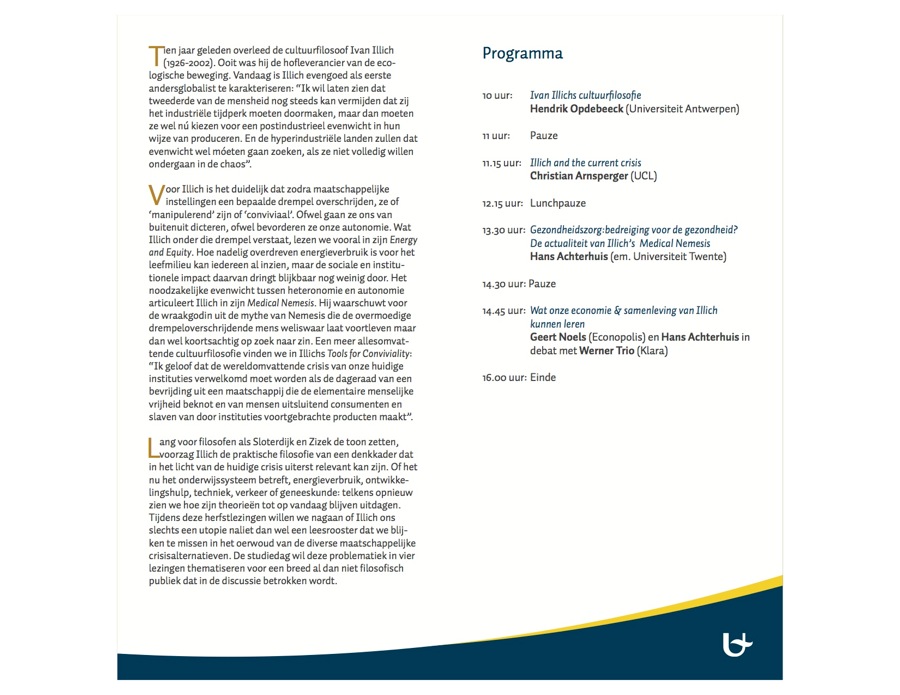
The Antwerp event is to take place Dec. 1 at the university there. One of our spies, reporting from Holland, writes:

It's from 10 till 16, and the speakers will explore the legacy of Illich. The flyer says they "wish to explore whether Illich left us a utopia, or a guide we're currently missing in the jungle of alternatives for the crisis" (free translation). There will be three lectures, concluded with a debate between the speakers. Of the speakers, the only one I'm familiar with is Hans Achterhuis, our "denker des vaderlands" (thinker of our country, some sort of title they give to a philosopher each year). Occasionally I stumble across an article or interview with him, in which he quite regularly quotes Illich. In the Netherlands, he is somewhat famous for his book De markt van welzijn en geluk (The market of well-being and happiness, I don't know wether it is translated in other languages) in which he gives a critique on our welfaresystem, based on Illich.


Illich flyerIllich 2

Monday, November 05, 2012

Illich in Russian

We've just stumbled onto a crowd-sourced translation project whose goal is to produce a Russian translation of Ivan Illich's Tools for Conviviality (Инструменты для добрососедства). Only 2% of the book has been translated, so far. All who can help are invited to join in. The same website, Translatedby.com, also is hosting a similar English-to-Russian translation of Deschooling Society, or Дешколирование общества.

Sunday, October 28, 2012

David Cayley 's Latest: "The Myth of the Secular"

Canadian Broadcasting has just made David Cayley's latest series of programs, "The Myth of the Secular," available for downloading as MP3 podcasts. There are five parts, each one about 54 minutes long. They are available here, off the Web, or via iTunes. Or, the shows may be listened to on the Web, starting here.


Part 1

Western social theory once insisted that modernization meant secularization and secularization meant the withering away of religion. But religion hasn't withered away, and this has forced a rethinking of the whole idea of the secular. IDEAS producer David Cayley talks to Craig Calhoun, Director of the London School of Economics, and Rajeev Barghava of India's Centre for the Study of Developing Societies.


Part 2

The secular is often defined as the absence of religion, but secular society is in many ways a product of religion. In conversation with IDEAS producer David Cayley British sociologist David Martin explores the many ways in which modern secular society continues to draw on the repertoire of themes and images found in the Bible.


Part 3

Early in the post-colonial era, politics in most Muslim countries were framed in secular and nationalist terms. During the last thirty years, the Islamic revival has dramatically changed this picture. Anthropologist Saba Mahmood talks with IDEAS producer David Cayley about her book, The Politics of Piety.


Part 4

The Fundamentals was a series of books, published by the Bible Institute of Los Angeles between 1910 and 1915, which tried to set the basics of Christianity in stone. Fundamentalism now refers to any back-to-basics movement. Malise Ruthven's Fundamentalism asks what all these movements have in common, in this feature interview with David Cayley.


Part 5

"All significant concepts of the modern theory of the state are secularized theological concepts." So wrote German legal theorist Carl Schmitt in a book called Political Theology. American legal theorist Paul Kahn has just published Political Theology: Four New Chapters in which he argues that the foundations of the American state remain theological. He explores this theme with IDEAS producer David Cayley.


Also available from CBC in podcast form is Cayley's five-part program, "The Scapegoat: René Girard's Anthropology of Violence and Religion." It is an excellent introduction to Girard's thinking:

Human beings, according to French thinker René Girard, are fundamentally imitative creatures. We copy each other's desires and are in perpetual conflict with one another over the objects of our desire. In early human communities, this conflict created a permanent threat of violence and forced our ancestors to find a way to unify themselves. They chose a victim, a scapegoat, an evil one against whom the community could unite. Biblical religion, according to Girard, has attempted to overcome this historic plight. From the unjust murder of Abel by his brother Cain to the crucifixion of Christ, the Bible reveals the innocence of the victim. It is on this revelation that modern society unquietly rests. Girard's ideas have influenced social scientists over his long career as a writer and teacher.

Ivan Illich mentions Girard at some length in his notes at the back of Shadow Work, and in the book The Challenges of Ivan Illich, Jean-Pierre Dupuy attempts to find some common ground between the two men, both of whom Dupuy has worked with closely. We'd be curious to know what, if anything, Illich and Girard thought of each other's thinking and analysis of history and Christianity.

One hint: Gene Burkart wrote this in an email last January: "I remember Ivan once saying […], in an off hand remark, that Girard had made the concept of sacrifice hopelessly confusing for people."


Saturday, October 27, 2012

More celebrations of Illich, in Austria and Italy

We've just learned of two more Illich events planned for the coming weeks. In Lucca, Italy, Dec. 1 and 2:

LA CASSETTA DEGLI ATTREZZI

IVAN ILLICH 10 ANNI DOPO

a cura de Il Granchio di Kuchenbuch


And in Eisenstadt, Austria, Nov. 7-9:

Ivan Illich, Gedenktagung

Among those participating will be Barbara Duden, Marianne Gronemeyer, and Martina Kaller, Illich's biographer.

Friday, October 05, 2012

Recalling a visit to CIDOC

Now a design consultant, writer and educator, Rodney Clough visited CIDOC in 1971, to attend a seminar on "interpersonal relational networks," organized by cybernetician Heinz von Foerster. (We wrote about this CIDOC event early last year.) At a website serving as a Festschrift for the Austrian von Foerster, Clough remembers his visit, which had its moments:

I did not know Heinz, nor did I know the other seminar participants, save one, Gordon Pask, a "cybernetician," whom I had heard lecture in New York two months earlier. I can blame June 21 [the day he arrived at CIDOC] on cybernetics, for it was cybernetics that lured me, caught me and beached me on the Mexican plateau.

"You're a day late."

I was listening to my other Cuernavaca host, Ivan Illich, with whom I had corresponded briefly and who suggested I attend this seminar.

"You printed the wrong day in the catalog," I countered, pointing to the catalog, which read, "Interpersonal Relational Networks, June 22." Ivan Illich shrugged me off and launched an "annoying-and-at-the-same-time-charming" non sequitur, "We have something for everybody."

He did. ...

Clough ranks as the first person we've ever seen use the word effulgent.

Traffic report

We were pleased, this morning, to discover from the Blogger dashboard that New Scare City's total page view count has crossed the 15,000 mark. The bulk of our visitors are from the US, followed by Canadians, Britons, and those from Germany, France, and Italy.

Ivan Illich, 10 years later

Ivan Illich died in December, 2002, and now, 10 years on, a number of get-togethers are being planned here and there to celebrate his life and work.

Affiche  Ivan Illich copie

In Paris, Nov. 29 and 30, École Normale Supérieure - Vivre et penser avec Ivan Illich. Dix ans après

Colloque organisé par Martin Fortier, Nicolas Nely et Thierry Paquot dans le cadre du Club de la Montagne Sainte-Geneviève


29 novembre
« Une vie en exemple, une pensée en héritage »

30 novembre, 1er décembre
« Devenirs et avenirs de la critique illichienne »


Plus d’informations prochainement


In Mexico, Dec. 13-15 - information here:

2012 ivan 72

And in Croatia, at the University of Rijeke - details are tentative, but probably Dec. 6, according to Iva Rincic (irincic [at] medri [dot] hr), Assistant Professor, Department of Social Sciences and Medical Humanities.

Finally, as we wrote earlier, there will a symposium in Bremen in early December, and here are the details. (The title translates roughly as "Jester in Absurdistan?")

Einladung1 2 Dezember2012 FIN

Thursday, October 04, 2012

Recent Papers on Illich

We've just learned of some newly-published papers about Ivan Illich. We've not had a chance to read them, but we look forward to doing so. Until then, here's what we know:

In April, 2011, Western New England University's School of Law held an all-day symposium devoted to Ivan Illich. The title: Radical Nemesis: Re-envisioning Ivan Illich's Theories on Social Institutions.

Now, that school's law review has published a set of papers presented at the conference, as follows. All of these are available in PDF format for downloading at no charge:

SYMPOSIUM: RADICAL NEMESIS: RE-ENVISIONING IVAN ILLICH’S THEORIES ON SOCIAL INSTITUTIONS: FOREWORD
Jennifer L. Levi

ILLICH (VIA CAYLEY) ON PRISONS
Giovanna Shay

ILLICH, EDUCATION, AND THE WIRE
Erin E. Buzuvis

“FOR TOMORROW WILL WORRY ABOUT ITSELF": IVAN ILLICH’S DESCHOOLING SOCIETY AND THE REDISCOVERY OF HOPE
Jared Gibbs

EXCHANGE AS A CORNERSTONE OF FAMILIES
Martha M. Ertman

SHADOW WORKS AND SHADOW MARKETS: HOW PRIVATIZATION OF WELFARE SERVICES PRODUCES AN ALTERNATIVE MARKET
Bridgette Baldwin

FROM WISCONSIN TO EGYPT AND BACK AGAIN: A COMMENT ON BRIDGETTE BALDWIN’S ANALYSIS OF THE SHADOW WORK THESIS
Davarian L. Baldwin

DESCHOOLING THE NEWS MEDIA—DEMOCRATIZING CIVIC DISCOURSE
Akilah N. Folami

THE PLACE OF LAW IN IVAN ILLICH’S VISION OF SOCIAL TRANSFORMATION
Bruce K. Miller


Meanwhile, a journal published by Wiley called Educational Theory has published this paper: "Ivan Illich's Late Critique of Deschooling Society: 'I Was Largely Barking Up the Wrong Tree'," by Rosa Bruno-Jofré and Jon Igelmo Zaldívar. The Wiley abstract states:

In this article, Rosa Bruno-Jofré and Jon Igelmo Zaldívar examine Ivan Illich's own critique of Deschooling Society, and his subsequent revised critique of educational institutions and understanding of education, within the context of both his personal intellectual journey and the general epistemological shift that started to take shape in the early 1980s. Bruno-Jofré and Zaldívar consider how, over time, Illich refocused his quest on examining the roots (origin) of modern certitudes (such as those related to education) and explored how human beings are integrated into the systems generated by those “certainties.” Illich engaged himself in historical analysis rather than providing responses to specific contemporary problems, while maintaining an interest in the relation between the present and the past. Under the metaphors of the word, the page, and the screen, he identified three great mutations in Western social imaginaries and the reconstruction of the individual self. Bruno-Jofré and Zaldívar argue that while his written work, including Deschooling Society, generally had an apophatic character, his critique of education, particularly in the late 1980s and 1990s, is intertwined with his analysis of the parable of the Good Samaritan and his belief that modernity is an outcome of corrupted Christianity.

Monday, September 24, 2012

Iatrogenesis - "retained surgical items"

New York Times - Sept. 24, 2012 - When Surgeons Leave Objects Behind:

On an overnight shift in 2005, Sophia Savage, a nurse in Kentucky, felt a crushing pain in her abdomen and started vomiting.

The next day she underwent a CT scan, which led to a startling diagnosis: A surgical sponge was lodged in her abdomen, left behind, it turned out, by a surgeon who had performed her hysterectomy four years earlier.

Ms. Savage’s doctor ordered immediate surgery to remove the sponge.

“What they found was horrific,” Ms. Savage said. “It had adhered to the bladder and the stomach area, and to the walls of my abdominal cavity.”

The festering sponge had spread an infection, requiring the removal of a large segment of Ms. Savage’s intestine. She sued the hospital where the hysterectomy had taken place, and in 2009 she won $2.5 million in damages. But the award has been appealed, and her life has been in tatters. Suffering from severe bowel issues and unable to work, Ms. Savage, 59, has been racked by anxiety and depression. Most days, she said, she cannot bring herself to leave home.

“I never dreamed something like this would happen to me,” she said.

Every year, an estimated 4,000 cases of “retained surgical items,” as they are known in the medical world, are reported in the United States. These are items left in the patient’s body after surgery, and the vast majority are gauzelike sponges used to soak up blood. During a long operation, doctors may stuff dozens of them inside a patient to control bleeding.

Though no two cases are the same, the core of the problem, experts say, is that surgical teams rely on an old-fashioned method to avoid leaving sponges in patients. In most operating rooms, a nurse keeps a manual count of the sponges a surgeon uses in a procedure. But in that busy and sometimes chaotic environment, miscounts occur, and every so often a sponge ends up on the wrong side of the stitches. ….

Friday, September 07, 2012

After Atheism, a 5-part radio series by David Cayley

Friend and interviewer of Ivan Illich, David Cayley has produced a series of quite interesting radio programs about religion for the CBC. They don't specifically mention Illich, but anyone who has listened to Cayley's The Corruption of Christianity radio program or read the accompanying book, The Rivers North of the Future, will likely appreciate this new program a good deal. We have, anyway.

The program is called After Atheism, and it consists of five interviews with thinkers, some believers, some not, who have been delving into religion and faith from a modern point of view. For instance, John Caputo is an expert in the philosophy of deconstruction, as put forth by Jacques Derrida, and he finds that method of analyzing texts very helpful in understanding Christianity. Indeed, he came to the surprising conclusion that Derrida himself had been thinking along religious lines right from the beginning, a thought that the radical and presumably atheistic philosopher eventually confirmed quite explicitly.

William Cavanaugh, meanwhile, has looked carefully at how religion and state relate to each other. Put simplistically, he finds that in certain ways, the state itself has created religion as a foil, as something whose clutches it can claim to have saved society from and thereby justify itself.

James Carse wonders what religion is and finds that belief actually has little to do with it. Instead, the great religions look to him like never-ending conversations, endlessly fascinating to those involved -- and to those on the outside, too -- because they attempt to answer questions -- could a guy nailed to a cross, for instance, really be god? -- that seem impossible to answer. The intent is not actually to answer these questions conclusively -- that would end the conversation -- but to make sure that the questions remain in play, so to speak. This leads Carse to some interesting thoughts on death, too -- and much more.

We're unable to do Cayley or his interview subjects justice. Anyone interested, however, can download and listen to his program as a set of five podcasts, available (at no charge) through the iTunes store or here on the CBC Ideas podcast page.

We highly recommend these shows, and especially to anyone who, like us, has sought to grapple with the religious aspects of Illich's thought. Like many people, we suspect, we came to Illich through his early books, about tools and schools, about hospitals and cars. There, Christian thought was quite implicit, lurking very far in the background. Only the occasional hint shined through - an intriguing citation of Thomas Aquinas in the introduction to Tools for Conviviality, for instance. It was clear enough to his readers that Illich was a Christian believer, but he made a point of never relying on biblical references, for instance, to buttress his critiques of major institutions. He knew better, he would later admit, than to lose his audience that way. Towards the end of his life, though, and largely in the interviews he gave to a well-informed and deeply appreciative David Cayley, he made his religious beliefs more explicit. And looking back, it's quite clear that those beliefs were always there, informing his thought, shaping his understanding much as we, for one, suspected all along but never were quite able to pin down.


Powered By Blogger

Moi

Santa Rosa, California, United States
Writer, photographer, music fan; father and husband living in northern Calif.