NEW SCARE CITY

It's a fictional streetscape we wander, here, a metropolis whose buildings, boulevards, and back alleys are in a constant state of flux. This is every place, and yet, no place at all - a city of dreams and a dream of a city.

Here, we explore the life and work of Ivan Illich and his circle of collaborators. There's no comprehensive index to the articles published, but we invite you to use the Search box, to the left, and to explore the Archive links that appear at the bottom of each page. Comments are welcomed.

Friday, November 23, 2012

Barcelona, too

We are pleased to hear from a reader, Silvia Grünig, who writes:

In this moment I'm finishing my Ph.D. thesis Ivan Illich: la ville conviviale at IUP-Institut d´Urbanisme de Paris, with M.Thierry Paquot.

Unhappily there is no Ivan Illich reader's group in Barcelona, but on 2th december a mess will take place at 11.30 at Parroquia Sant Jaume, Hermanitas del cordero, Carrer Ferrán 28, 08002 Barcelona, and a few friends will eat together.

Paquot, a professor of urban studies, authored a tribute to Illich in Le Monde in January, 2003. He also wrote the preface to the Ouvres completes collection of Illich's work. And he is one of the organizers of the 3-day Illich event scheduled to take place next week in Paris. Additional information about that colloquium has been made available here and a program is available here. Ms. Grünig will be one of the speakers, providing an update on her research.

Thursday, November 22, 2012

And another, in Bozen - "For a friendly future!"

Another Illich event - Dec. 17, in Bozen, aka Bolzano, Italy

Bozen, 17. Dezember 2012 um 17.30 Uhr (Altes Rathaus): Für eine freundliche Zukunft! - Eine Überlegung zur Ökologische Wende und deren Wünschbarkeit, nach Rio 2012 und zum Todesjubiläum von Ivan Illich. Franz Tutzer, Franz Egger, Riccardo della Sbarba, Alberto Filippi, Hans Schmieder, tauschen Meinungen und Lösungsvorstellungen mit dem Publikum.

Illich bio available in Italian

Martina Kaller-Dietrich's biography of Ivan Illich has been translated into Italian. What appears to be a review is published here.

Any plans for an English translation?

Wednesday, November 21, 2012

An event in Bologna

And yet another Illich event, planned for Monday, Dec. 17. Mr. Franz Tutzer -- a longtime Illich scholar and author of this impressive bibliography of Illich's work -- kindly sent us this:

Lettura Dossetti 2012

Tuesday, November 20, 2012

Yet another celebration, in Bern

We've been informed of another celebration of Ivan Illich, scheduled to take place Dec. 6 in Bern, Switzerland. A flyer for the event reads like so:


Ivan Illich interpretiert das Gleichnis vom Samariter

Donnerstag, 6. Dezember 2012, 20 Uhr, im Berner Münster


Ivan Illich, geboren 1942 in Wien und verstorben vor 10 Jahren, am 2. Dezember 2002, studierte Naturwissenschaften, Philosophie und Theologie. 1961 gründete er in New York das «Center oft intercultural Formation». In der Folge setzte er sich in der Lehre und in seinen Tätigkeiten in Nord- und Zentralamerika und in Europa (auchin seinem Schrifttum) intensiv mit den Grundlagen der abendländischen Kultur und der Rolle des Christentums auseinander. Vieles davon stellte er radikal in Frage. Er empfiehlt, das theologische Wirken und das spirituelle Leben als lebendige Sorge für die Menschen in unserer Zeit zu verstehen.
Zu seinen wichtigsten Schriften gehören: ‚Entschulung der Gesellschaft‘, ‚Die Nemesis der Medizin‘, ‚Genus. Zu einer historischen Kritik der Gleichheit’ und ‚In den Flüssen nördlich der Zukunft. Letzte Gespräche über Religion und Gesellschaft‘.

Das Gleichnis vom barmherzigen Samariter (Lk 10, 25-37) aus dem Lukas Evangelium war der Leitstern im Leben des Historikers und gläubigen Christen Ivan Illich, eine Textstelle, um die sein Denken und Tun kreiste. Dabei interpretierte er die Geschichte, mit welcher Jesus die Frage eines Schriftgelehrten „Wer ist mein Nächster?“ beantwortete, in einer neuen und radikalen Weise. Der Samariter, der den geschlagenen Juden aufhob und seine Wunden verband, handelte nicht nach einer Regel oder einem vorher gesetzten „Soll“, als er sich dem Mann aus einem fremden oder gar feindlichen Stamm zuwandte. Er handelte in freier, frei gewählter Zuwendung. Diese Zuwendung birgt seitdem die Möglichkeit, ein einzigartiges Verhältnis zu einem anderen Menschen herzustellen, ein Verhältnis jenseits aller Normen. Für Ivan Illich stiftete also Jesu Auskunft im Lukas Evangelium eine bis dahin undenkbare, ja anstössige Grundlage, um die höchste Form der Bezüglichkeit zu einem anderen Menschen durch einen freien Akt herzustellen.

Barbara Duden, Professorin für Soziologie an der Universität Hannover und langjährige Le-bensgefährtin von Ivan Illich, stellt die Texte vor und kommentiert sie.

Henriette Cejpek, Schauspielerin am Stadttheater Bern, liest Texte von Ivan Illich.

Sandra Mangini, Sängerin und Schauspielerin, Venedig, singt traditionelle italienischeLieder.

Der Abend ist gleichzeitig Abschluss der fünfjährigen Auslegung des Lukas Evangeliums durch Maja Zimmermann-Güpfert, Münsterpfarrerin.

Jean Robert video

Some video has appeared on YouTube showing Jean Robert discussing his friend and collaborator, Ivan Illich. The animated Robert is seated in a plush arm chair that swivels, talking in Spanish with several other people seated around a coffee table. There are two clips, actually, one 28 seconds long, the other nearly 8 minutes. Both have the title: "Seminario Iván Illich." Here's the longer one:


And the shorter one:

A Recent Paper Available Online

Last month, here, we noted the publication of a paper, "Ivan Illich's Late Critique of Deschooling Society: 'I Was Largely Barking Up the Wrong Tree'," by Rosa Bruno-Jofré and Jon Igelmo Zaldívar. We've just noticed that the full text of this paper, in a journal called Educational Theory, is available on line right here.

[CORRECTION: As of Jan. 1, 2013, the link we provided here no longer works.]

Monday, November 19, 2012

More celebrations, at State College and in Antwerp

Just as we were saying to a friend that it seemed no events were planned in the U.S. to mark the tenth anniversary of Ivan Illich's death, word has arrived that there will, in fact, be a small celebration at Penn State. And we've also been informed of an event planned for Antwerp, Belgium.

The Penn State affair will take place Dec. 3, from 7 to 8:30PM, with a panel of faculty members remembering Illich's life and contributions. All are welcome to attend, light refreshments will be served. The event will be held in 112 Walker Building. More information is available from the estimable Dana L. Stuchul.

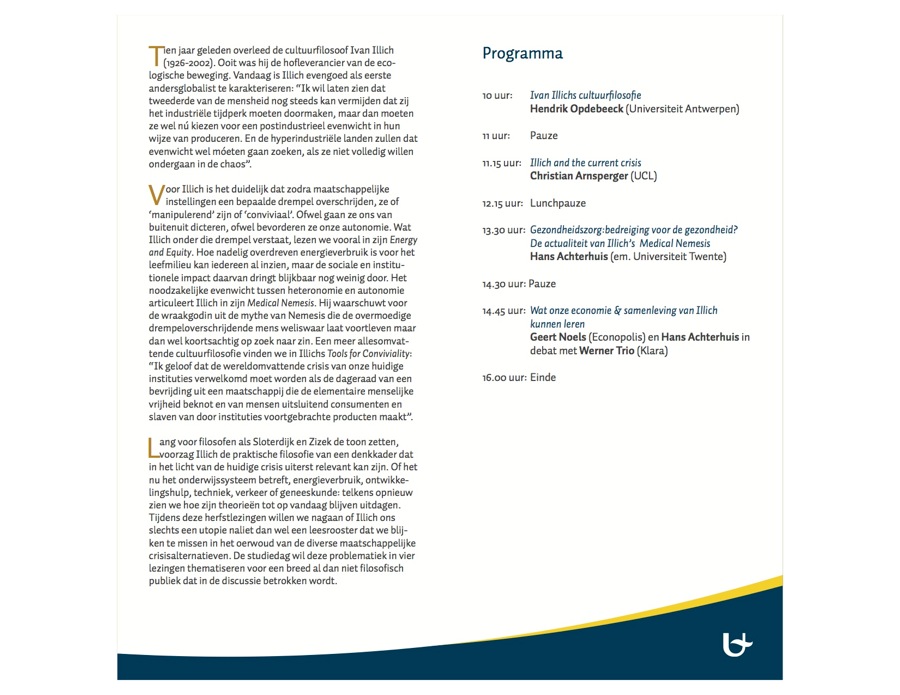
The Antwerp event is to take place Dec. 1 at the university there. One of our spies, reporting from Holland, writes:

It's from 10 till 16, and the speakers will explore the legacy of Illich. The flyer says they "wish to explore whether Illich left us a utopia, or a guide we're currently missing in the jungle of alternatives for the crisis" (free translation). There will be three lectures, concluded with a debate between the speakers. Of the speakers, the only one I'm familiar with is Hans Achterhuis, our "denker des vaderlands" (thinker of our country, some sort of title they give to a philosopher each year). Occasionally I stumble across an article or interview with him, in which he quite regularly quotes Illich. In the Netherlands, he is somewhat famous for his book De markt van welzijn en geluk (The market of well-being and happiness, I don't know wether it is translated in other languages) in which he gives a critique on our welfaresystem, based on Illich.


Illich flyerIllich 2

Monday, November 05, 2012

Illich in Russian

We've just stumbled onto a crowd-sourced translation project whose goal is to produce a Russian translation of Ivan Illich's Tools for Conviviality (Инструменты для добрососедства). Only 2% of the book has been translated, so far. All who can help are invited to join in. The same website, Translatedby.com, also is hosting a similar English-to-Russian translation of Deschooling Society, or Дешколирование общества.

Sunday, October 28, 2012

David Cayley 's Latest: "The Myth of the Secular"

Canadian Broadcasting has just made David Cayley's latest series of programs, "The Myth of the Secular," available for downloading as MP3 podcasts. There are five parts, each one about 54 minutes long. They are available here, off the Web, or via iTunes. Or, the shows may be listened to on the Web, starting here.


Part 1

Western social theory once insisted that modernization meant secularization and secularization meant the withering away of religion. But religion hasn't withered away, and this has forced a rethinking of the whole idea of the secular. IDEAS producer David Cayley talks to Craig Calhoun, Director of the London School of Economics, and Rajeev Barghava of India's Centre for the Study of Developing Societies.


Part 2

The secular is often defined as the absence of religion, but secular society is in many ways a product of religion. In conversation with IDEAS producer David Cayley British sociologist David Martin explores the many ways in which modern secular society continues to draw on the repertoire of themes and images found in the Bible.


Part 3

Early in the post-colonial era, politics in most Muslim countries were framed in secular and nationalist terms. During the last thirty years, the Islamic revival has dramatically changed this picture. Anthropologist Saba Mahmood talks with IDEAS producer David Cayley about her book, The Politics of Piety.


Part 4

The Fundamentals was a series of books, published by the Bible Institute of Los Angeles between 1910 and 1915, which tried to set the basics of Christianity in stone. Fundamentalism now refers to any back-to-basics movement. Malise Ruthven's Fundamentalism asks what all these movements have in common, in this feature interview with David Cayley.


Part 5

"All significant concepts of the modern theory of the state are secularized theological concepts." So wrote German legal theorist Carl Schmitt in a book called Political Theology. American legal theorist Paul Kahn has just published Political Theology: Four New Chapters in which he argues that the foundations of the American state remain theological. He explores this theme with IDEAS producer David Cayley.


Also available from CBC in podcast form is Cayley's five-part program, "The Scapegoat: René Girard's Anthropology of Violence and Religion." It is an excellent introduction to Girard's thinking:

Human beings, according to French thinker René Girard, are fundamentally imitative creatures. We copy each other's desires and are in perpetual conflict with one another over the objects of our desire. In early human communities, this conflict created a permanent threat of violence and forced our ancestors to find a way to unify themselves. They chose a victim, a scapegoat, an evil one against whom the community could unite. Biblical religion, according to Girard, has attempted to overcome this historic plight. From the unjust murder of Abel by his brother Cain to the crucifixion of Christ, the Bible reveals the innocence of the victim. It is on this revelation that modern society unquietly rests. Girard's ideas have influenced social scientists over his long career as a writer and teacher.

Ivan Illich mentions Girard at some length in his notes at the back of Shadow Work, and in the book The Challenges of Ivan Illich, Jean-Pierre Dupuy attempts to find some common ground between the two men, both of whom Dupuy has worked with closely. We'd be curious to know what, if anything, Illich and Girard thought of each other's thinking and analysis of history and Christianity.

One hint: Gene Burkart wrote this in an email last January: "I remember Ivan once saying […], in an off hand remark, that Girard had made the concept of sacrifice hopelessly confusing for people."


Powered By Blogger

Moi

Santa Rosa, California, United States
Writer, photographer, music fan; father and husband living in northern Calif.