NEW SCARE CITY

It's a fictional streetscape we wander, here, a metropolis whose buildings, boulevards, and back alleys are in a constant state of flux. This is every place, and yet, no place at all - a city of dreams and a dream of a city.

Here, we explore the life and work of Ivan Illich and his circle of collaborators. There's no comprehensive index to the articles published, but we invite you to use the Search box, to the left, and to explore the Archive links that appear at the bottom of each page. Comments are welcomed.

Saturday, October 31, 2009

Decisive Moments

articleLarge.jpg


Halloween, South Bronx, 1991, photo by Angel Franco of The New York Times. The trick-or-treater is Guissette Muniz, then age 6.


I remember seeing this photo when it first appeared in the paper back in '91, and from then on, if I wasn't already, I made a point of keeping my eye out for Mr. Franco's work. Today, the Times has a story about Ms. Muniz and her family, about the moment that this photo captures and where life has taken each of the family's members since then.
'"I consider myself a princess,” [Ms. Muniz] admitted. ...“That’s what I am. I think highly of myself. I don’t want to toot my own horn, but I think I’m a great girl, and I deserve the best in life. I’m not cocky, but you have to have confidence.”'

Part of what makes this photo work, I think, is its tilt - Angel's angle? - which underlines the idea that not all is OK in this landscape and corner of the city. Indeed, the South Bronx had been ravaged by arson and crack and years of neglect. Off-kilter, indeed.

As I recall, this image originally was published as one of a series by Mr. Franco. It's unfortunate, I think, that the Times' archive does not contain many of the photos that appeared in the paper - for reasons of copyright, no doubt. But they make up for this with the Lens blog, which is superb, a smart appreciation of photography, then and now. Which reminds me: Just the other day, for no apparent reason, my eye lingered for a long moment on a book on the shelf next to my desk - Photographs, by Roy DeCarava. I should look at that book again, I thought to myself, but I didn't. And then: Later that day, or the day after, I read on the Times' website - indeed, in the Lens blog itself - that Mr. DeCarava had just died, age 89. His photos are masterful in their use of light and shadow - an observation that may sound banal, but just look for yourself. There is a true painterly quality to his images. (I'd steal one to present here, but Lens is clever enough to protect its image sequences against such acts by presenting them in Adobe Flash. Lens presents 14 of his fotos, including a wonderful one of Duke Ellington in 1967, caught in an unguarded moment. And quite a few others of jazzers. More of his work is available at the most commendable Masters of Photography site.)

More on Roth's The Humbling

In a review on CounterPunch this weekend, Professor Charles R. Larson, at American University in Washington, D.C., points out what's missing from Roth's latest novel, The Humbling.

It's "the menacing social and political contexts. There are absorbing characters and erotic regeneration, but Roth’s greatest novels typically depict Americans brought down by the forces of the country’s hypocrisy. This time, Roth keeps everything in plain sight, reducing much of the fear of the unknown, leaving little for the reader to ponder."


How true. I should have thought of that.

I have noticed Roth submitting himself to being interviewed by Tina Brown on The Daily Beast and his publisher taking out a full-page ad in The Times for this book, which together make me wonder if the book is not doing so well.

Tuesday, October 20, 2009

Portrait of the Artist in a Negative Mood

Self2.jpg


Philip Roth x 2

Two small items featuring one of my very favorite authors:

Last June, the NYTimes wrote about someone having sampled Roth's voice to create a piece of hip-hop music. It's kinda silly, but fun to hear the man's voice and catch a glimpse of his sense of humor. I gather he is good at voices.

More recently, the NJ Star-Ledger caught up with Roth as he joined a bus tour of Newark, the city where he grew up and that serves as the setting for many of his stories. He had a grand time, surprising the others on the tour who, like him, but 10 years later than his 1950 date, had graduated from Weequahic High School. The Ledger's piece quotes from several of Roth's books, including this bit of lovingly remembered detail from Goodbye Columbus:

“The park ... was empty and shady and smelled of trees, night and dog leavings; and there was a faint damp smell too, indicating that the huge rhino of a water cleaner had passed by already, soaking and whisking the downtown streets.”


Thought this morning I oughta try to read all of his books. So far, for the record, I've read these: American Pastoral, Operation Shylock, Patrimony, The Humbling, Sabbath's Theater, The Plot Against America, I Married a Communist, and first of all, Portnoy's Complaint, which made me laugh out loud on the NYC subway. And that's without having tried too hard, over the course of 13 years.

Wednesday, October 14, 2009

Yojimbo, Mac tool extraordinaire

I recently acquired a program called Yojimbo that has, in a word, made my life much simpler. I think of it as a smart box, or archive, into which I can store all the stuff I collect while stumbling around the Web. That's in contrast to a dumb, inert folder.


Yojimbo is the garage, or attic or basement, that I always needed for my always-expanding collection of Web pages, text clippings, images, bookmarks, and receipts - all the stuff, in other words, that I grab, sometimes with no good reason beyond it's being available to grab. But it's a garage that is self-organizing, constantly ordering and indexing its contents for easy retrieval. Garage with butler included!


In the past, these collected items would get stored willy-nilly in my computer. Some languished in my Mac's Downloads folder, most others just cluttered by desktop. Every so often, I might do some house-cleaning and shuffle items into this folder or that - a Reads, folder, for instance, for storing all those news, magazine, and Web page articles that I fully intended eventually to read, someday, somehow, in the future, when I happened to have the time and actually remembered that they existed. This Reads folder itself was contained in a folder I long ago labled Stuff - a sprawling collection of items, many but not all of them organized in folders: images, documents, bookmarks, MP3 music files, you name it.


Yojimbo is a better Stuff folder, a program-and-container into which it's particularly easy to put things. I can, for example, just ask to print any document or web page I like and, in the usual drop-down menu, select "PDF to Yojimbo". Voila - the item is stored under 'jimbo's control, complete with any tags I may wish to add. Or, I can click on another button in my browser to store a page's URL in YJ. Or, I can hit the F8 button my keyboard and any text or image I have selected will get stored, again with tags. Finally, I can drag items to a 'jimbo tab that sits patiently on the far left edge of my desktop; this action automatically stores the items, too.


When I need to find an item, YoJ is way helpful, too. It provides a spiffy Mac-style interface with a scrolling list of all stored items. This list is easily searched, the items's titles, textual content, and tags all available near-instantly. A preview pane shows selected items but one can also open items in their own windows, print them, or drag them to the desktop as normal files. Clicking a bookmark launches the appropriate page in the default Web browser. In addition, items are organized into categorical folder off to the left - URLs, images, receipts, your choice, etc. - to make finding things easier, too. Smart folders can be created that automatically include items that contain specified keywords. (I haven't used it, yet, but a crypto function can hide chosen items from prying eyes, too.)


That's YoJo in a nutshell - a well-designed program that really does the job. I wish I had had this to use many years ago.

The Humbling, by Philip Roth

I have just read Philip Roth's latest novel, The Humbling. Perhaps novella is a better word. It's short.
I enjoyed it, a good deal, even, but I have to wonder what the point is he's trying to make. An aging actor figures he's all washed up, can't act, but then, he finds himself in an unlikely affair, feels much happier; but then, complications ensue, and .... I won't spoil it. There's more to it than that, actually. There are echoes, for sure, of Sabbath's Theater, a marvelous book that, by chance, I read just a few weeks ago, but in that story, Roth is playing (masterfully) a massive pipe organ, all stops out, wrestling with Death. In The Humbling, he appears to be using a simpler keyboard and only dabbling. The characters are well drawn and convincing, the story well told, the sex quite Rothianic, but in the end I am left wondering. This book is a miniature and I am not sure that, Roth-wise, it is breaking much new ground. But I may well be missing something.

Henry Green

Reading Henry Green's book Loving, published in 1949. It's rich in dialog and dialect - maids and servants and butlers in a big rambling house in Ireland, during the war.

I found this in that bottomless fount of wisdom, Wikipedia: In his 1975 memoir Here at The New Yorker, Brendan Gill relates that during a luncheon at the Ritz Hotel, New Yorker editor William Shawn asked [Henry] Green what had led him to undertake the writing of Loving. Green replied, "I once asked an old butler in Ireland what had been the happiest time of his life. The butler replied, 'Lying in bed on Sunday morning, eating tea and toast with cunty fingers.'"

I look forward to finishing this book and getting on with his memoir, which I just took from the library this evening - Pack My Bag.

Wednesday, March 21, 2007

Lee Hoinacki, Ivan Illich's longtime collaborator, has just published a book: Dying is Not Death (Resource Publications/Wipf & Stock Pubishers). It "examines from a traditional, humanistic position the act of dying" and includes a chapter specifically focusing on "the ways Illich faced pain and his own death." Some chapters, Hoinacki says, are projects that Illich asked him to do but that had not been completed by the time of Illich's death in December, 2002.

Friday, July 22, 2005


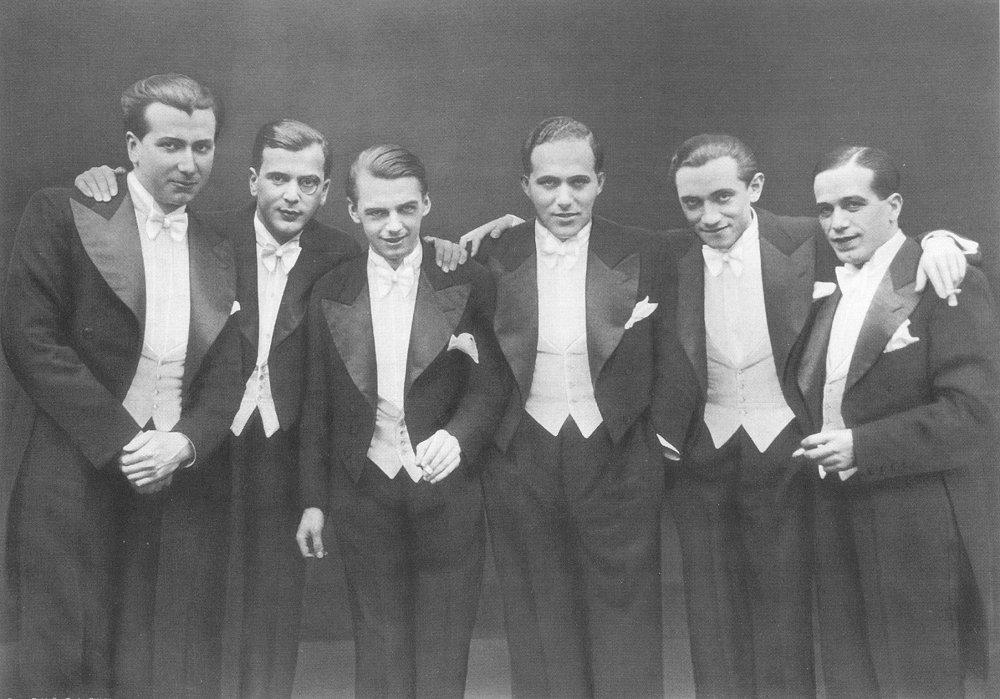
Here, in case you don't recognize them, are the Comedian Harmonists, one of the musical marvels of the 20th Century. They're on their way, here, I believe, to New York, where they will be received as near-superstars. I post this image because I happen to be their world's No. 1 biggest fan.


These six men formed an a capella singing group in 1927, in Berlin, and for the next 7 years, they took Germany, the Continent, and the United States by storm. They were Big - almost Beatles big, a true sensation, turning out dozens of 78-rpm disks and performing in all of the biggest halls and appearing in more than a dozen feature films. To this day, their music is widely listened to in Germany and, increasingly, elsewhere.


Modeled on a U.S. group called The Revellers, the Comedian Harmonists sang in close, jazz-inflected harmony and used incredibly rich and inventive arrangements. They sang jazz and pop and classical music - including, even, a 5-minute rendition of the complete overture to The Barber of Seville. They were renowned for being able to mimic all sorts of musical instruments solely with their voices - trumpets, strings, even entire horn sections - and they showed great wit and style: They usually appeared on stage in tuxedos ...


... yet their songs might be about such silliness as owning a pet cactus or having an uncle in Karumba who danced the rhumba.


One of the six, Erwin Bootz, played piano - a true accompanist, he added just the right amount of foundation and melodic filligree and never intruded on the vocals. The others sang precisely-arranged parts:


- Harry Frommermann, the group's founder, sang tenor
- Asparuch ("Ari") Leschnikoff, a Bulgarian, sang first tenor
- Erich Abraham Collin sang second tenor
- Josef Roman Cycowski, from Poland, sang baritone, and
- Robert Biberti sang bass.


Formed and achieving great stardom during the Weimar Republic, the Comedian Harmonists represent a distillation of much that was great in Germany at that time - a European sophistication and urbanity and playfullness and above all, supreme musicality. But like so many German artists of that era, they eventually fell afoul of the Nazis and those gangsters' systematic racism. Three of the Harmonists' members happened to be Jewish, a fact that in Nazi leaders' eyes created a serious contradiction: How could Jews be such superstars, so popular with the German volk - and with international audiences, too? Under increasing pressure, the three Jews in the group left Germany in 1934 and suddenly, the Comedian Harmonists were kaput. Though the two halves of the original group - one left behind in Germany, the other landing first in Austria - each hooked up with new singers, neither remnant could recreate the magic.


Fortunately, a great deal of their splendid music was captured on disk and is available in a variety of CD editions. My advice: Run, don't walk. This is truly great music, the human voice at its best. There is a movie to watch, too, made in Germany in 1999 - The Harmonists - which retells the group's story in a somewhat fictionalized narrative. It's widely available here in the U.S.


It is moving, I think, to recall how different a world it was when music like this - so sophisticated, musically and lyrically - was some of the most widely-heard and appreciated pop music of the day. Likewise, of course, all of the swing that was on the radio, in dancehalls, and in jukeboxes here in America during the '30s and '40s. The Mills Brothers, a jazzy, classy, close-harmony singing group popular in the U.S., then, were clearly inspired by the Comedian Harmonists.


There are websites to visit, too, of course: One very informative and extensive collection of information, biographies, lyrics, and even MP3s is available, in English and German, right here.
Powered By Blogger

Moi

Santa Rosa, California, United States
Writer, photographer, music fan; father and husband living in northern Calif.